
Strategic Report 2026 Strategic Synergy between POAS, AI Optimization and Performance Systems in E-Commerce. Comprehensive ROAS to POAS transition analysis, case studies and Bigconvert ecosystem expertise.
The global and local e-commerce market is currently going through the most profound period of structural transformation in the last decade. The transition from effervescent expansion based on cheap traffic acquisition to a mature, highly competitive market dominated by artificial intelligence algorithms requires a radical change in performance evaluation models.
This analysis explores the fundamental transition from surface metrics, such as ROAS (Return on Ad Spend), to absolute financial sustainability metrics, represented by POAS (Profit on Ad Spend). The report details the technical implementations required, validates these models through complex case studies, and highlights the pioneering expertise of the Bigconvert ecosystem, which has implemented these solutions since 2018.
Chapter 1: Fundamentals of the E-Commerce Ecosystem and the Mathematical Failure of ROAS
E-Commerce Market Context and Pressure on Margins
Aggregated data for the e-commerce market in Romania indicate an accelerated maturation, but also an intensification of competition. The local market reached a value of approximately €8.06–8.1 billion in 2025 and is projected to exceed €8.56 billion in 2026.
Medium-term forecasts estimate that the market volume will reach $12.14 billion by 2031. This increase in absolute value is accompanied by an increase in average revenue per user (ARPU), which has evolved from €484 in 2022 to a projection of ~€900 by 2027.
However, growth is not uniform and does not guarantee profitability for all players. While the number of transactions has stagnated (growing just 0.8% in certain quarters since 2025), the average order value has increased, denoting much more cautious consumer behavior.
⚠️ External competition exerts enormous pressure. The expansion of non-EU platforms such as Temu (4.7 million monthly active users in Romania alone in 2025) is redefining consumer expectations. 65% of users say their purchasing decisions are directly influenced by AI solutions.
Anatomy and Limitations of ROAS
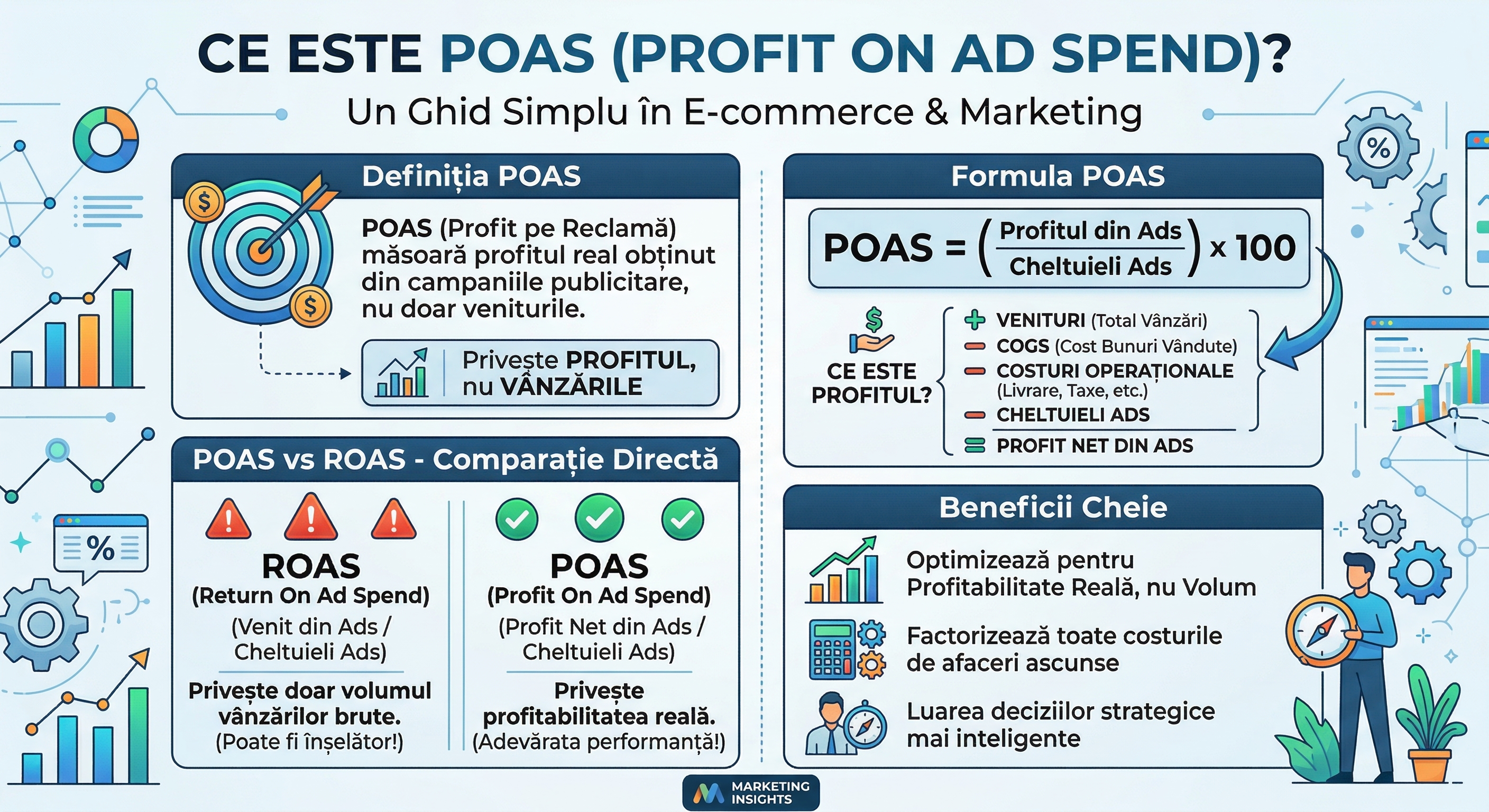
ROAS strictly measures the ratio between the revenue generated and the cost allocated to advertising. For example, a campaign that generates $3,000 in revenue from a $1,000 investment reports an ROAS of 300% (or 3.0x).
But ROAS completely ignores profit margins and actual operating costs: cost of goods sold (COGS), logistics fees, promotional discounts, payment processor fees, and packaging costs.
A campaign with an ROAS that looks flawless on the marketing platform dashboard can, in reality, bankrupt the company by silently eroding working capital.
The Mathematical Demonstration: Why ROAS Misleads
🔍 Critical takeaway: The marketing manager reporting solely on ROAS will consider both campaigns to be performing equally well. A rigorous financial analysis shows that Campaign B's budget generated only $10,000 profit (POAS = 1, breakeven), while Campaign A multiplied the value 10 times.
Definition and Strategic Role of POAS
Profit on Ad Spend (POAS) removes distortions by replacing revenue with actual gross profit. A POAS > 1 indicates positive profitability, guaranteeing that the amounts invested bring operational dividends.
Using POAS completely changes the structure of advertising campaigns: products with high volumes but apparently low ROAS receive more budget if they have higher margins, correcting the historical inefficiencies of standard algorithms.
Chapter 2: POAS as Asymmetric Competitive Advantage and the Role of Bigconvert
Uninterrupted experience as e-commerce operators and developers of performance-based solutions since 2018. The fact that the global market is only now discovering POAS underlines the value of a partner who has refined these processes over many years.
Genesis of the Bigconvert Ecosystem
The Bigconvert ecosystem was founded by Ovidiu Golea and Răzvan Pepelea on a foundation of "radical honesty and deep technical knowledge". The absolute differentiator is the founders' experience of being hands-on e-commerce operators themselves, not just report providers.
Product XL Technology: Profitable Data Architecture
Bigconvert has developed its own technological infrastructure Product XL the point of convergence between e-commerce platforms, accounting data and advertising algorithms.
Price as a Ranking Factor
Ovidiu Golea, co-founder of Bigconvert: "Google deliberately hides products that display prices far above the market benchmark. Google maximizes CTR an overpriced product has a tiny CTR, so the algorithm automatically favors competitive offers. Lack of alignment with the market price kills ad impressions before the potential customer even has a chance to click."
Chapter 3: Server-Side Tracking & Smart Bidding Technical Architecture
The Decline of Client-Side Tracking
Merchants systematically lose between 5% and 20% of their total tracked conversions due to: prematurely closed tabs, slow redirects from payment gateways, ITP policies on Apple and Ad-Blocker extensions.
The structural solution is Server-Side Tracking. The e-commerce platform sends data through secure APIs (Google Ads API, Meta Conversions API), bypassing browser limitations.
CPA Benchmark on Google Ads Industries
The Four Pillars of POAS Integration
Server-side containers in the same geographic region as the audience, for minimal latency and accurate attribution.
Subtract from the order value ALL variable costs: COGS, shipping, commissions, packaging, handling fees.
Profit Action becomes Primary Conversion Action. The "Income" action moves to the secondary observation role.
Target ROAS becomes Target POAS. Gradual reduction by 15-20%, with CPC monitoring for 48h per iteration.
Chapter 4: Case Studies Performance Turned into Net Profit
📊 International Plutonic Study
The brand stopped scaling "high ROAS distractions" and recalibrated Google's algorithms to prioritize profit margin efficiency. The results: in just 6 months.
🌍 BEAUTYCOS International Study
Navigating the complexity of a colossal inventory and multi-jurisdictional logistics, BEAUTYCOS achieved a mixed POAS of 51% across multiple jurisdictions, facilitating expansion from 5 to 17 European markets from a position of financial strength.
Transformations in Native Environment Bigconvert Customers
The migration to POAS restored clear visibility into the health of each product segment. It enabled the immediate detection of unnecessary cost centers that were imperceptibly eroding margins, strengthening a sustainable long-term platform.
The integration of Product XL and AI data enrichment has doubled sales volumes while completely flattening operational costs. Scale without penalizing profitability.
Automating data update per SKU saved tens of hours monthly. The budget has been surgically redirected to items of high financial performance.
Margin analysis has streamlined interaction with a catalog of thousands of products with infinite variations, mathematically highlighting the most sought-after AND most profitable segments.